
Why Super-Oxygenated Water Works
The Science Behind Safe, Sterilised Drinking Water
Super-oxygenated water science explains how advanced purification and controlled oxygen enrichment work together to produce clean, biologically safe drinking water. At SupaO², our technology is designed first and foremost around human safety, water quality, and consistency — not just how water looks, but how safe it truly is.
This page explains the science behind SupaO² drinking water, the treatment principles involved, and why our approach goes beyond standard filtration systems.
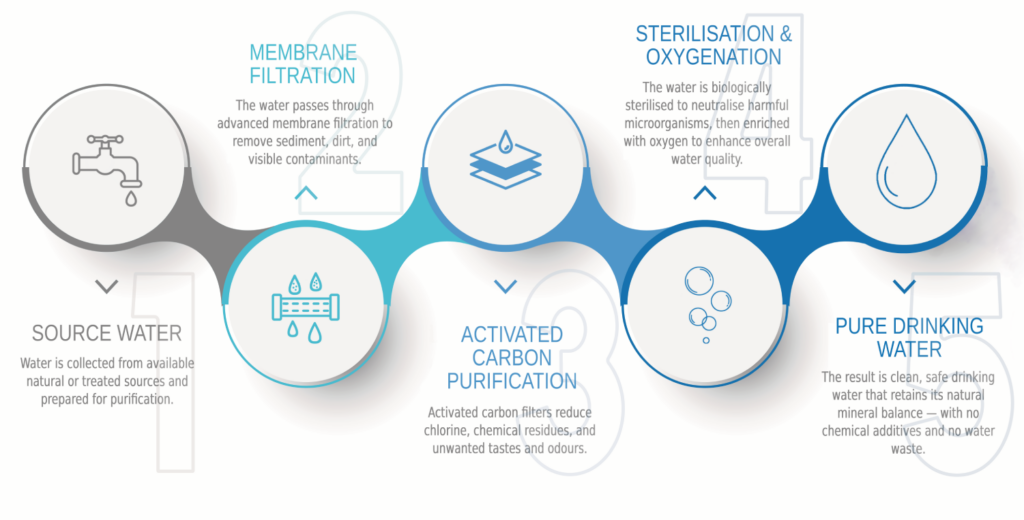
SupaO² drinking water is produced using a multi-stage process that:
Removes physical contaminants using membrane filtration
Reduces chlorine and chemical residues using activated carbon
Sterilises water to neutralise harmful microorganisms
Enriches water with dissolved oxygen to enhance freshness
Retains naturally occurring minerals without water waste
These principles align with modern drinking-water treatment science, not wellness trends.
The Science of Super-Oxygenated Drinking Water
Water that appears clear is not necessarily safe. True drinking water safety requires addressing three categories of contaminants:
Physical (sediment, particles)
Chemical (chlorine, organic compounds)
Biological (bacteria, viruses, protozoa)
Modern water science shows that multi-stage treatment systems are required to reliably address all three categories, especially where water quality may vary.
Advanced Water Purification: The Foundation of Safety
Membrane Filtration – Removing What You Can See
Membrane filtration is widely used in drinking-water treatment to reduce suspended solids and larger microorganisms. This stage forms the first protective barrier, removing visible and particulate contamination before further treatment.
Why it matters: removing particles improves downstream purification effectiveness and water clarity.
Activated Carbon – Reducing Chemicals and Improving Taste
Activated carbon adsorption is a well-established method for reducing:
Chlorine
Organic chemical residues
Taste and odour compounds
Carbon filtration improves palatability and chemical stability, making water safer and more pleasant to drink.
Why Sterilisation Matters in Drinking Water
Filtration alone does not guarantee microbiological safety. Research and public-health authorities consistently show that drinking water must include a disinfection or sterilisation step to neutralise harmful pathogens.
Both UV-based and oxidation-based sterilisation methods are internationally recognised for drinking-water safety
This is why SupaO² incorporates sterilisation principles aligned with modern water-treatment systems — ensuring water is biologically safe, not just visually clean.
The Role of Oxygen in Drinking Water Quality
Oxygen enrichment in SupaO² systems is not presented as a health treatment, but as a water-quality enhancement.
Scientific research into dissolved oxygen and micro-/nano-bubble technology shows that smaller bubbles improve gas-transfer efficiency and help maintain elevated dissolved-oxygen levels for longer periods
Oxygen-enriched water is commonly described as fresher and more stable, complementing purification and sterilisation rather than replacing them.
Super-Oxygenated Water vs Basic Filtration Systems
Many household water systems rely on simple filtration, which can improve taste and clarity but does not address biological risk.
Reverse osmosis systems, while effective at contaminant removal, are known to:
Strip naturally occurring minerals
Waste significant volumes of water
The U.S. EPA notes that point-of-use RO systems can waste multiple litres of water for every litre produced
SupaO² is designed to:
Sterilise water without chemicals
Retain natural mineral balance
Avoid unnecessary water waste
Evidence-Led Design and Real-World Application
SupaO²’s approach is informed by:
Established drinking-water treatment science
Proven filtration and sterilisation technologies
System performance in real-world environments
Rather than relying on a single method, SupaO² integrates multiple complementary processes, reflecting how safe drinking water is produced at scale.
Conclusion: Science-First Drinking Water
Super-oxygenated water works when built on proper purification, sterilisation, and controlled oxygenation — not marketing claims.
SupaO² delivers:
Clean, sterilised drinking water
Mineral-balanced quality
Chemical-free purification
No water waste
All grounded in recognised water-treatment science
FAQ
Super-oxygenated drinking water is purified and sterilised water enriched with dissolved oxygen to enhance freshness and water quality.
Yes. When produced using proper filtration and sterilisation processes, it follows established drinking-water safety principles.
Most filters only address particles and taste. SupaO² combines filtration, carbon purification, sterilisation, and oxygen enrichment to address physical, chemical, and biological risks.
No. SupaO² is designed to retain naturally occurring minerals while avoiding the water waste associated with reverse osmosis systems.
No. SupaO² makes no medical claims. Oxygen enrichment supports water quality and freshness only.
Source Reference Index
Water purification overview – ScienceDirect
https://www.sciencedirect.com/topics/chemical-engineering/water-purificationUltrafiltration overview – Pentair X-Flow
https://xflow.pentair.com/en/our_technology/ultrafiltration.htmlActivated carbon treatment – US EPA
https://www.epa.gov/sdwa/overview-drinking-water-treatment-technologiesOzone disinfection – US EPA
https://www.epa.gov/sites/default/files/2015-06/documents/ozon.pdfUV disinfection – Government of Western Australia
https://www.health.wa.gov.au/Articles/U_Z/Ultraviolet-disinfection-of-drinking-waterNanobubble oxygen research – ScienceDirect
https://www.sciencedirect.com/science/article/pii/S3051003125000217Reverse osmosis water waste – US EPA
https://www.epa.gov/watersense/point-use-reverse-osmosis-systems
Super-oxygenated water