
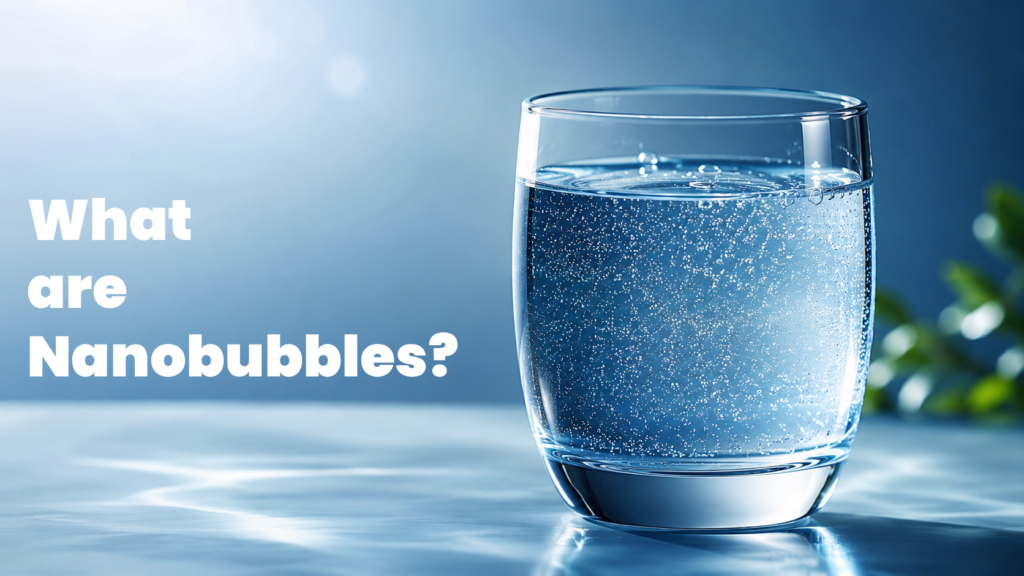
What are Nanobubbles and why do they matter in drinking water?
Not all drinking water is the same.
Two glasses of water may look identical, but the way that water has been treated can be very different. Some systems focus on removing almost everything from the water. Others focus only on basic filtration. SupaO² takes a different approach: it treats water through advanced filtration, sterilisation, and oxygen-based enhancement — while preserving its natural mineral balance.
One of the most exciting parts of this process is the use of extremely fine bubbles, often referred to as nanobubbles or ultrafine bubbles.
Nanobubbles are already being researched and used in agriculture, aquaculture, wastewater treatment, and industrial water systems because of the way they help gases such as oxygen remain suspended in water for longer. The same science helps explain why oxygen-enriched water is such an important part of the SupaO² approach.
This article explains what nanobubbles are, why they behave differently from ordinary bubbles, and why they matter in drinking water.
What are Nanobubbles?
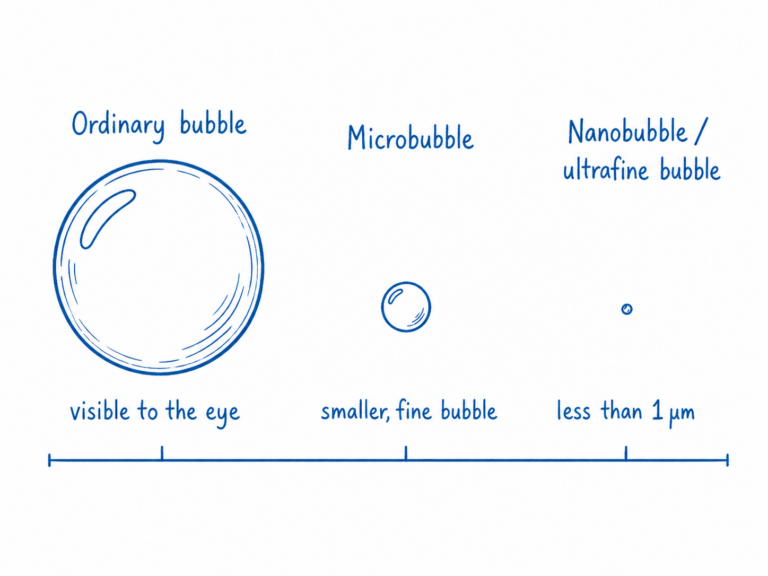
Nanobubbles are extremely small gas bubbles suspended in liquid. In the field of fine bubble technology, the term “ultrafine bubble” is commonly used for bubbles with a diameter of less than 1 micrometre (µm), according to ISO terminology for fine bubble technology.
To put that into perspective, these bubbles are far smaller than the bubbles you see in sparkling water or a glass of soda. Ordinary bubbles rise quickly to the surface and escape. Nanobubbles behave differently.
Because of their tiny size, they can remain suspended in water much longer than visible bubbles. Research has shown that nanobubbles have unusual properties, including stability in water, high surface area relative to volume, and charge-related behaviour that helps explain why they do not behave like ordinary bubbles.
This is why nanobubble technology is being explored in water treatment systems, agriculture, aquaculture, and environmental applications.
Why Ordinary Bubbles Are Not Enough
Most people understand oxygen in water through visible bubbles. If you see bubbles, you assume the water is oxygenated.
But visible bubbles are not necessarily effective at transferring oxygen into water. Large bubbles rise quickly and burst at the surface. Much of the gas escapes before it can dissolve.
Nanobubbles are different because they are so small that they behave more like suspended particles than normal bubbles. A review of ultrafine bubble behaviour explains that for very small bubbles, random motion in the water can dominate over the upward rising motion that affects larger bubbles. Japan’s Academic Journals
That matters because the longer oxygen remains in contact with water, the better the opportunity for gas transfer and dissolved oxygen stability.
This is why companies working in advanced irrigation and dissolved oxygen systems focus so strongly on nanobubble and dissolved oxygen technology. BioTherm’s explanation of nanobubble systems, for example, highlights the role of tiny, stable bubbles in improving oxygen delivery and water performance in agricultural systems.
For SupaO², the drinking water application is different from farming, but the principle is similar:
Better oxygen transfer can help create better water.
Why Dissolved Oxygen Matters
Dissolved oxygen, often shortened to DO, refers to oxygen that is present within water rather than sitting above it as air.
In agriculture, dissolved oxygen is widely discussed because plant roots rely on oxygen-rich water for healthy growth. In water treatment and environmental systems, dissolved oxygen can also influence biological activity, freshness, and stability.
For drinking water, the point is not to make exaggerated health claims. The value is more practical and product-focused:
- oxygen-enriched water can taste fresher
- oxygen can form part of an advanced treatment process
- dissolved oxygen supports the overall SupaO² positioning of water that is treated, balanced, and enhanced rather than stripped
Research into nanobubble systems has shown that oxygen nanobubble water can increase dissolved oxygen concentration compared with ordinary water under studied conditions. – National Library of Medicine
This supports the broader concept that nanobubble technology can be used to improve how oxygen is introduced and retained in water.
Nanobubbles and Water Treatment
Nanobubbles are increasingly being explored in water and wastewater treatment. A review from researchers at the University of Bath notes that nanobubbles have attracted attention because of their stability and other distinctive properties, including high surface area-to-volume ratio and surface charge behaviour.
Nature Index also describes nanobubble technology as involving stable gas-filled cavities, often below 200 nm, with properties that can support water treatment processes, including mass transfer.
In practical terms, this means nanobubbles can help gases interact with water more effectively than ordinary bubbles.
This is important because SupaO² is not simply a “filter”. It is a multi-stage water treatment system designed to produce drinking water that is:
- filtered
- sterilised
- oxygen-enhanced
- mineral-balanced
The nanobubble concept supports the oxygen-enhancement side of that process.
How SupaO² Uses Oxygen in Drinking Water
SupaO² uses a combination of water treatment stages rather than relying on a single method.
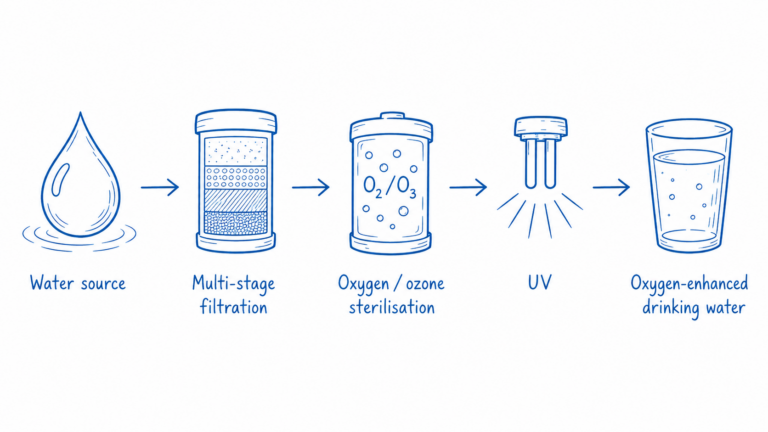
The process can include:
- Multi-stage filtration
This removes sediment and physical impurities from the water. - Sterilisation
Oxygen, ozone, and ultraviolet light are used as part of the treatment process to help disinfect water. - Oxygen enhancement
Oxygen is introduced into the water at a fine level, supporting dissolved oxygen and freshness. - Mineral retention
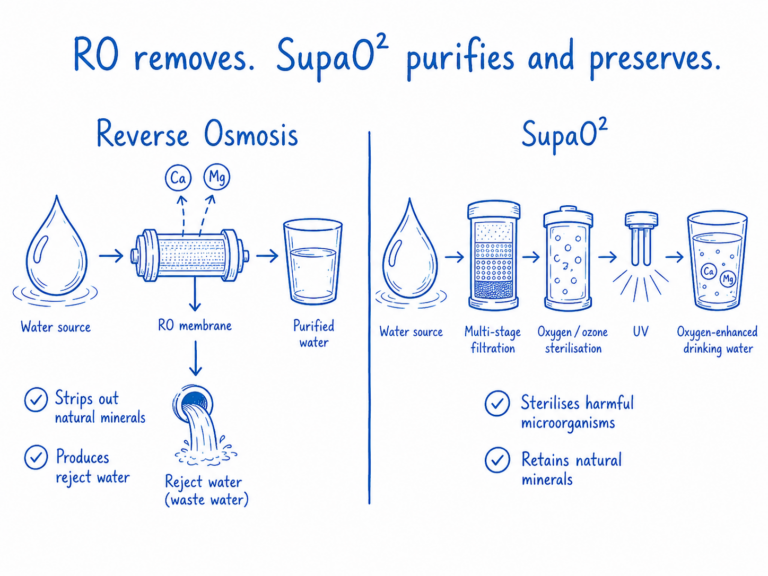
Unlike reverse osmosis, SupaO² does not focus on stripping everything out of the water.
This is the key difference.
Reverse osmosis systems are effective at removing many dissolved substances, but they also remove naturally occurring minerals. This often requires remineralisation to restore taste and balance.
SupaO² takes a different approach:
Sterilise the water, preserve the minerals, and enhance it with oxygen.
Nanobubbles vs Ozone: What’s the Difference?
This is an important point because people often confuse oxygenated water, ozonated water, and nanobubble water.
They are not the same thing.
Ozone is a powerful oxidising agent often used in water treatment and disinfection. It can be useful during treatment, but ozone itself is not the main “consumer benefit” in the final drinking water message.
Oxygenation refers to increasing oxygen within the water.
Nanobubble technology refers to the way tiny gas bubbles can remain suspended and improve gas transfer into water.
So, in simple terms:
- ozone can be used as part of the sterilisation process
- oxygen supports the oxygen-enriched nature of the water
- nanobubble technology helps explain how gases can be held in water more effectively
This distinction matters because SupaO² should not be understood as “just an ozonator”. It is a broader multi-stage system that combines filtration, sterilisation, and oxygen-based enhancement.
Why This Is Different From Reverse Osmosis
Reverse osmosis has become common in the water industry, but it is not the only way to produce high-quality drinking water.
RO works by forcing water through a membrane. This removes many dissolved solids, but it also removes natural minerals and produces reject water.
For some applications, RO is useful. But for drinking water where taste, mineral balance, and water efficiency matter, many consumers and businesses are now looking for alternatives.
SupaO² is positioned differently.
Instead of stripping the water down and then rebuilding it, SupaO² focuses on:
- removing physical impurities
- sterilising harmful microorganisms
- preserving mineral balance
- enhancing oxygen content
- reducing unnecessary water waste
This gives SupaO² a clear place in the market:
An advanced drinking water system for people who want more than ordinary filtration, but do not want reverse osmosis.
UV Light and Water Sterilisation
Ultraviolet light is a well-established method used in drinking water disinfection. The US Environmental Protection Agency has published guidance on the use of UV light for drinking water disinfection by public water systems.
UV works by affecting microorganisms in a way that prevents them from reproducing effectively. It is commonly used as part of water treatment systems where microbial control is required.
The World Health Organization also provides global drinking-water quality guidance that forms a basis for regulation and standard setting around the world.
For SupaO², this matters because the product story should not be reduced to “filtered water”.
The better message is:
Filtered, sterilised, mineral-balanced drinking water.
Why Nanobubbles Matter for SupaO² Drinking Water
Nanobubbles matter because they help explain one of the key differences in the SupaO² approach.
SupaO² is not only removing unwanted material. It is also improving the water through oxygen-based treatment.
This gives the brand several clear advantages in communication:
1. It makes oxygen visible as a benefit
Most people understand filtration, but they do not understand oxygen-enhanced water. Nanobubbles help explain how oxygen can be introduced and held in water more effectively than through ordinary bubbling.
2. It supports the “not RO” positioning
Reverse osmosis removes. SupaO² treats and enhances.
That is a much stronger message.
3. It reinforces freshness and quality
Consumers may not understand nanobubbles technically, but they can understand the result: water that is clean, balanced, and fresh-tasting.
4. It gives SupaO² a science-backed story
Nanobubble technology is being researched across multiple industries, from agriculture to water treatment. This gives SupaO² an innovation story that feels credible and modern.
What This Means for the Person Drinking the Water
For the person choosing drinking water for their home, office, or bottled water brand, the details can be simplified:
SupaO² water is designed to be:
- clean
- sterilised
- mineral-balanced
- oxygen-enhanced
- produced without reverse osmosis waste
SupaO² doesn’t just filter water — it creates better drinking water.
Final Takeaway
Nanobubbles are tiny, but their role in modern water treatment is significant.
Because they behave differently from ordinary bubbles, they can help oxygen remain in water longer and support more effective gas transfer. For SupaO², this supports a new way of thinking about drinking water: not just filtered, but sterilised, mineral-balanced, and oxygen-enhanced.
In a world where many systems focus on removing everything, SupaO² focuses on creating better drinking water — clean, balanced, and designed for modern homes and businesses.
Contact us or see the current model options here.