
Why Reverse Osmosis Strips Minerals — And Why It Matters for Drinking Water
Why reverse osmosis strips minerals is an important question for anyone considering installing a water purification system. Reverse osmosis (RO) is often marketed as the gold standard of purity, but many people don’t realise that the process removes not only contaminants — it also removes beneficial minerals that naturally occur in water.
Understanding what reverse osmosis actually does helps you make a more informed decision about what you want from your drinking water.
What Is Reverse Osmosis?
Reverse osmosis (RO) is a water purification method that forces water through an extremely fine semi-permeable membrane under pressure. The membrane is designed to block:
Dissolved salts
Heavy metals
Bacteria
Viruses
Many chemical contaminants
In simple terms, RO works by allowing water molecules to pass through while rejecting most other dissolved substances.
That sounds ideal — and in many industrial and desalination settings, it is.
However, this same process also removes the naturally occurring minerals present in drinking water.
Why Reverse Osmosis Strips Minerals
To understand why reverse osmosis strips minerals, you need to understand how the membrane works.
Minerals such as:
Calcium
Magnesium
Potassium
Sodium
Trace elements
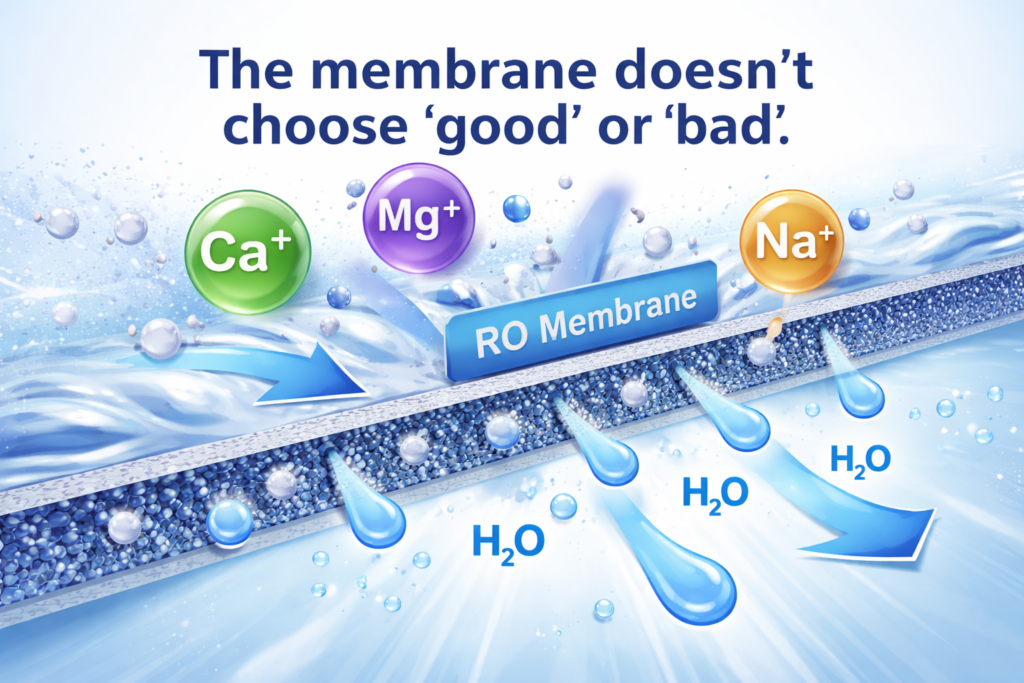
are dissolved in water as ions. The RO membrane does not distinguish between “good” dissolved substances and “bad” ones. It removes nearly everything that is not a pure water molecule.
This means:
Harmful contaminants are removed
Beneficial minerals are also removed
The result is highly purified, low-mineral water — often described as “demineralised”, “empty” or “flat”.
What Happens to the Removed Minerals?
Reverse osmosis systems produce two streams of water:
Purified water
Reject (or waste) water
The minerals and contaminants that are blocked by the membrane are flushed away in the reject stream. Depending on the system, this can mean several litres of water are discarded for every litre of purified water produced.
This is one reason RO systems are often associated with water waste, particularly in domestic settings.
Organisations such as the World Health Organization recognise reverse osmosis as an effective purification method, but also note that remineralisation is sometimes recommended after treatment.
Does Mineral Removal Matter?
This is where opinions often differ.
Minerals in drinking water contribute to:
Taste
Mouthfeel
Balance
Overall water character
Water with moderate mineral content often tastes smoother and more pleasant. Very low-mineral water can taste flat or slightly sharp.
From a nutritional standpoint, drinking water is not the primary source of minerals in most diets. However, minerals such as calcium and magnesium do contribute to overall intake and influence how water interacts with the body.
More importantly for many people, mineral retention affects how water feels and tastes on a daily basis.
Why Reverse Osmosis Water Often Needs Remineralisation
Because RO removes nearly everything, some systems include an additional remineralisation stage. This involves adding small amounts of minerals back into the purified water to improve taste and balance.
This raises an interesting point:
If minerals must be added back in, it suggests that completely stripping them out may not always be ideal for everyday drinking water.
The United States Environmental Protection Agency describes reverse osmosis as an effective method for contaminant removal, particularly in situations involving high salinity or specific pollutants. However, this level of treatment is not always necessary for already potable municipal water.
Reverse Osmosis vs Natural Mineral Balance
Municipal tap water in many areas already undergoes treatment and testing to ensure safety. While taste can vary, the mineral profile of tap water contributes to its character and stability.
When reverse osmosis is applied to already treated drinking water, it:
Removes remaining contaminants
Removes residual chlorine
Removes dissolved minerals
Produces very low total dissolved solids (TDS)
Low TDS water is often marketed as “pure”, but purity in this context simply means the absence of dissolved substances — not necessarily optimal balance.
The Taste Factor: Why Mineral Content Changes Flavour
Minerals play a major role in how water tastes.
For example:
Calcium can add smoothness
Magnesium can add slight bitterness in higher concentrations
Sodium influences perceived softness
When reverse osmosis removes these minerals, water can taste noticeably different. This is one reason some people describe RO water as “flat” or lacking character.
Taste is subjective, but mineral content is one of the key drivers of water flavour.
Is Reverse Osmosis Bad?
Reverse osmosis is not inherently “bad”. It is highly effective in specific contexts, such as:
Desalination
Removing high levels of contaminants
Industrial processes
Areas with unsafe source water
However, for everyday drinking water where the source is already potable, it may be more treatment than necessary.
The key question becomes:
Do you want water that is stripped down to nearly pure H₂O — or water that is purified while maintaining its natural mineral balance?
A Different Approach to Purification
Some modern systems focus on:
Physical filtration
Active sterilisation
Mineral retention
Avoiding chemical additives
Rather than removing everything and adding minerals back in later, these systems aim to preserve what is beneficial while eliminating what is harmful.
This approach prioritises:
Safety
Stability
Taste
Simplicity
How SupaO² Addresses Mineral Retention
SupaO² was designed with mineral retention in mind.
Instead of relying on reverse osmosis membranes, the system combines:
Multi-stage physical filtration
Oxygen-based sterilisation
Preservation of naturally occurring minerals
This allows harmful microorganisms to be neutralised without stripping the water of its natural character.
The result is water that is:
Safe
Mineral-balanced
Stable
Suitable for everyday drinking
If you’d like to explore whether this approach suits your home or business, you can contact us directly via our contact page.
Final Thoughts
Understanding why reverse osmosis strips minerals helps you move beyond marketing slogans and look at how purification methods actually work.
Reverse osmosis removes nearly everything from water — both harmful contaminants and beneficial minerals. While this level of treatment is valuable in certain situations, it may not always be necessary for everyday drinking water.
The right system depends on what you value most: absolute removal, or balanced purification that protects both safety and natural mineral content.