
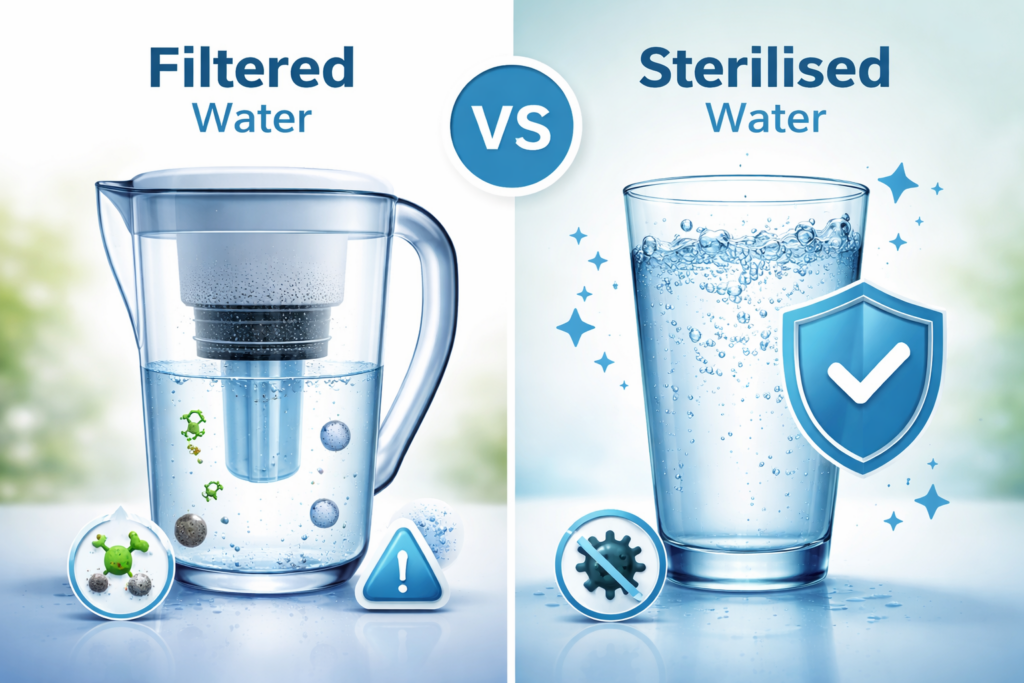
Filtered vs Sterilised Water: Why Clear Water Isn’t Always Safe to Drink
Filtered vs sterilised water is one of the most misunderstood topics in drinking water today. Many people assume that if water looks clean and tastes fine, it must be safe — but filtration and sterilisation are not the same thing, and the difference matters more than most people realise.
What Does “Filtered Water” Actually Mean?
When most people talk about filtered water, they’re referring to water that has passed through some form of physical barrier. This might be a jug filter, a carbon filter, or a multi-stage filtration system installed under a sink.
Filtration is very good at removing:
Sediment and particles
Chlorine and unpleasant tastes
Some heavy metals
Certain chemical contaminants
What filtration does not reliably do is neutralise or destroy microorganisms. Bacteria, viruses, and pathogens can still be present in water that looks crystal clear.
This is where the confusion begins: clear water is not the same as safe water.
Why Filtered Water Can Still Be Unsafe
Many harmful microorganisms are invisible to the naked eye. You can’t smell them, taste them, or see them — even under bright light.
Filtered water can still contain:
Bacteria such as E. coli
Viruses
Microbial contaminants introduced through ageing pipes or storage tanks
This is especially relevant in regions where municipal water infrastructure is under pressure, where pipes are old, or where water quality can fluctuate unexpectedly.
Filtration improves water appearance and taste, but it does not guarantee biological safety.
What Is Sterilised Water?
Sterilised water goes a step further. Instead of simply removing particles, sterilisation focuses on neutralising harmful microorganisms so they can no longer pose a risk.
Sterilisation methods aim to:
Kill bacteria and viruses
Prevent microbial regrowth
Deliver consistent biological safety
This is the key difference between filtration and sterilisation:
filtration removes, sterilisation neutralises.
Why Sterilisation Matters for Drinking Water
Drinking water safety is not just about what you remove — it’s about what you eliminate entirely.
Sterilisation is critical because:
Microorganisms can multiply over time
Storage tanks and pipes can reintroduce bacteria
Some pathogens are small enough to bypass filters
Without sterilisation, filtered water can become unsafe again, even after treatment.
According to the World Health Organization, microbiological contamination remains one of the leading causes of waterborne illness worldwide.
The Problem with “Looks Clean”
One of the most dangerous assumptions about water is that visual clarity equals safety.
Water can be:
Clear but biologically unsafe
Odourless but contaminated
Pleasant tasting but harmful
This is why relying on appearance alone is risky. Sterilisation addresses what filtration cannot see.
How Oxygen-Based Sterilisation Changes the Equation
Modern purification systems can sterilise water without harsh chemicals or aggressive processes.
Oxygen-based sterilisation works by:
Creating conditions that are hostile to harmful microorganisms
Improving overall water quality
Delivering consistent results without chemical residue
Unlike chlorine or ozone injection, oxygen-based approaches focus on stability and safety, not temporary treatment.
This method is particularly effective when combined with physical filtration, creating a system that both cleans and protects water.
Filtration vs Sterilisation: A Simple Comparison
Filtered Water
Removes particles and some contaminants
Improves taste and clarity
Does not guarantee biological safety
Sterilised Water
Neutralises bacteria and viruses
Delivers consistent safety
Protects water beyond initial treatment
The most effective systems don’t choose one over the other — they use both.
Why Many Home Systems Stop at Filtration
Many household water systems rely on filtration alone because:
Filters are familiar
They’re easy to market
They create immediate taste improvement
However, taste improvement is not the same as safety. Without sterilisation, filtered water remains vulnerable to microbial risks.
This is also why some bottled water brands still treat their water after filtration to ensure safety during storage and transport.
Why This Matters for Everyday Drinking Water
If you’re drinking water daily — at home, at work, or at school — consistency matters.
Sterilised water:
Reduces health risks
Provides peace of mind
Remains stable over time
This is especially important for families, offices, and environments where water is stored before use.
Bringing It Back to SupaO²
SupaO² was designed to address this exact gap between filtration and safety.
By combining:
Multi-stage physical filtration
Oxygen-based sterilisation
Mineral retention
the system delivers water that is not only clean, but genuinely safe to drink — without stripping beneficial minerals or relying on chemical additives.
If you’d like to understand whether this approach is right for your home or business, you can get in touch via our contact page.
Further Reading
To explore related topics in more depth:
Learn more about drinking water safety standards from the World Health Organization
Read about microbial contamination risks from the Centers for Disease Control and Prevention.
Final Thought
Filtered water can look clean, taste good, and still be unsafe. Sterilised water addresses what filtration alone cannot — biological safety.
Understanding the difference between filtered vs sterilised water is the first step toward making better decisions about what you drink every day.