
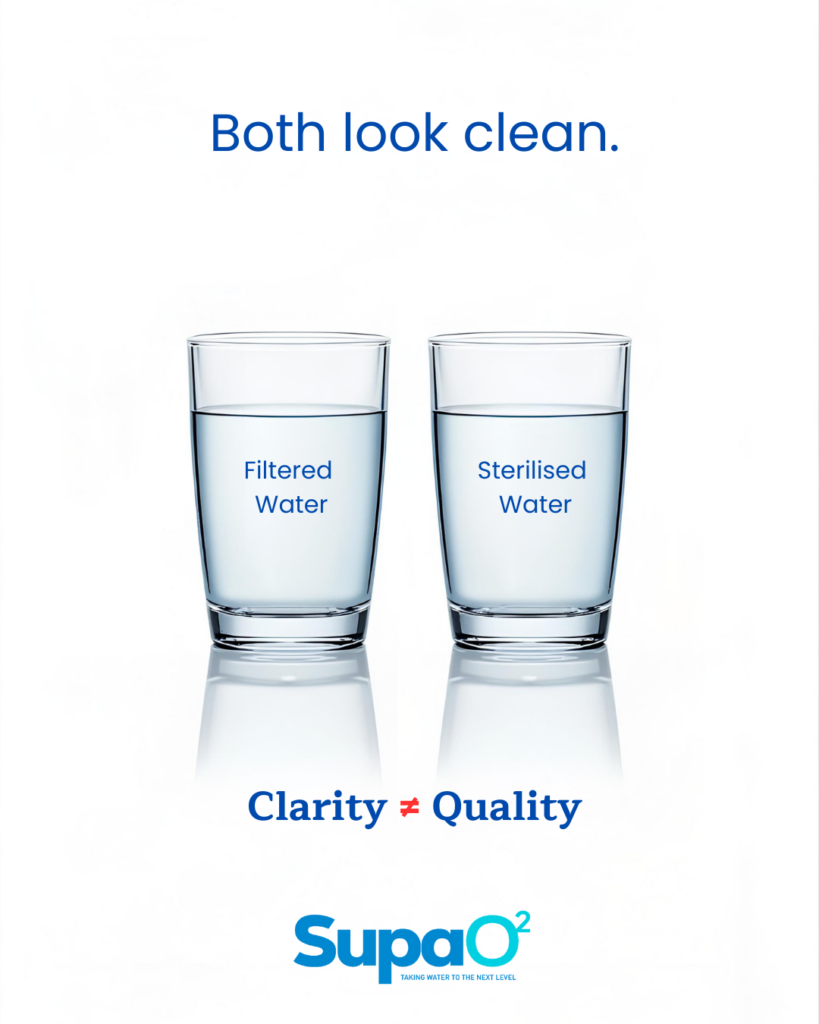
Clear Water Does Not Equal Quality Water: The Difference Between Filtered and Sterilised Water
Clear water is often assumed to be clean, safe, and suitable for drinking. If it looks transparent and has no obvious odour or taste, most people rarely question what might still be present in it.
However, clarity does not equal quality.
While many water treatment systems focus on making water look clean, visual clarity alone does not guarantee that water is biologically safe. To understand why, it’s important to look at the difference between filtered water and sterilised water — and why that distinction matters.
What Filtered Water Actually Means
Water filtration is designed to remove physical and chemical impurities from water. This typically includes:
Sediment and particles
Chlorine and some chemicals
Certain heavy metals
Odours and tastes
Filters work by passing water through media such as carbon, membranes, or other materials that trap or absorb unwanted substances. The result is water that looks clearer, tastes better, and feels more pleasant to drink.
But filtration has a limitation.
Most filtration systems are not designed to eliminate microorganisms.
Why Filtered Water Can Still Be Unsafe
Even after filtration, water may still contain:
Bacteria
Viruses
Protozoa
Biofilm-forming microorganisms
These organisms are microscopic, meaning they do not affect how water looks. Water can appear crystal clear while still harbouring microbes that pose health risks — particularly over long-term consumption.
In some cases, filtration can even create conditions that allow microbes to regrow downstream, especially in storage tanks or pipework where water sits for extended periods.
This is why filtered water and safe drinking water are not always the same thing.
What Sterilised Water Does Differently
Water sterilisation focuses on biological safety, not appearance.
Sterilisation processes are designed to inactivate or destroy microorganisms, rather than simply removing visible contaminants. Common sterilisation methods include:
Ultraviolet (UV) treatment
Ozone treatment
Thermal treatment (less common for drinking systems)
When properly applied, sterilisation significantly reduces the presence of harmful microbes and helps prevent regrowth after treatment.
Sterilised water addresses what filtration alone cannot:
the biological risks that you cannot see.
Filtered vs Sterilised Water: A Simple Comparison
| Filtered Water | Sterilised Water |
|---|---|
| Looks clean and clear | May look identical |
| Removes particles and some chemicals | Targets microorganisms |
| Improves taste and smell | Improves biological safety |
| Does not guarantee microbial safety | Reduces bacteria, viruses, and regrowth risk |
Both processes have value — but they serve different purposes.
Why Visual Clarity Is a Poor Measure of Water Quality
Human perception is a poor judge of water safety.
Historically, clear water was often assumed to be safe because visibly dirty water was obviously risky. Modern contamination, however, is rarely visible. Many of the microorganisms that cause illness thrive in water that looks perfectly clean.
Relying on clarity alone can create a false sense of security, especially in environments where water quality may fluctuate or where storage and distribution introduce new risks.
Why SupaO² Focuses on More Than Filtration
SupaO² was designed around a simple principle:
Water quality must be measured by safety and consistency, not appearance.
Rather than relying on filtration alone, SupaO² combines multi-stage filtration with sterilisation processes that address microbial risk. This approach helps ensure water is not only clean-looking, but biologically safer and more reliable over time.
By treating water beyond surface clarity, SupaO² focuses on what matters most for drinking water:
what remains in the water after it looks clean.
The Risk of “Clean-Looking” Water
One of the most common misconceptions around drinking water is that improvements in taste and appearance automatically mean improvements in safety.
In reality:
Clean-looking water can still be biologically compromised
Microbes do not announce their presence
Long-term exposure is often the real risk
Understanding this distinction allows homeowners and businesses to make more informed decisions about how their drinking water is treated.
Choosing Water Treatment With Intent
Not all water treatment systems are designed with drinking water quality in mind. Some are intended to improve taste, others to remove specific contaminants, and fewer are designed to address biological safety consistently.
Knowing the difference between filtered and sterilised water is the first step in choosing a system that aligns with how water is actually used — every day, over the long term.
Final Thoughts
Clear water may look reassuring, but clarity alone does not define quality.
True drinking water quality depends on what has been removed, what has been neutralised, and what risks remain unseen. Understanding the role of sterilisation alongside filtration helps bridge the gap between water that looks clean and water that is designed to be safe.
If you’d like to explore how this applies to your home or business, you can get in touch with us here.